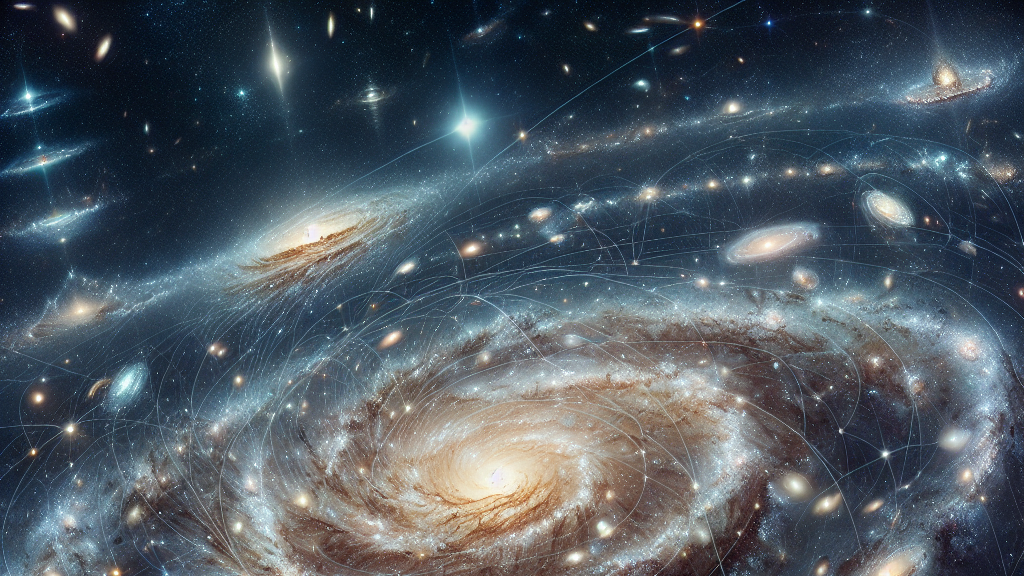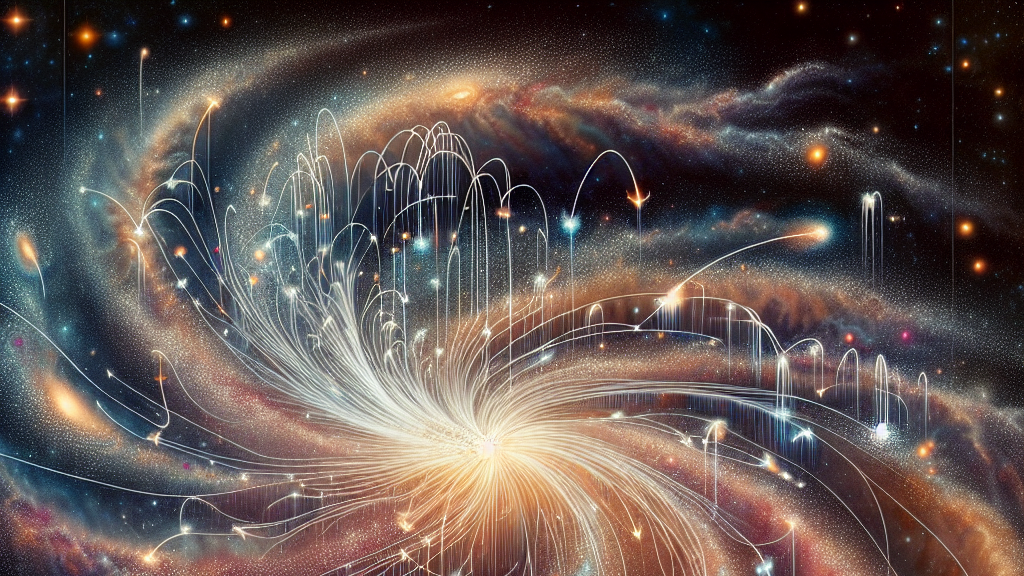
What if I told you that tiny bits of dust from planets might hold the secret to spreading life across the galaxy? That’s right! These minuscule particles, which were once part of planets like ours, can escape the gravitational pull of their home planet and embark on an interstellar journey, pushed outward by the pressure of starlight. This journey could potentially take them far away into the cosmos, where they might sow the seeds of life on other worlds.
Here’s how it works: Planetary dust particles are incredibly small, but once they’re free from a planet’s gravity, they can be pushed by radiation pressure—a kind of energetic force from sunlight that acts on them as they travel through space. With this push, they have the potential to reach speeds that allow them to escape solar systems entirely. As they journey through space, these particles have the opportunity to reach countless other star systems, potentially carrying with them the building blocks of life. Over a span of 5 billion years, these dust particles could visit as many as 100,000 stellar systems!
Imagine if this idea, known as panspermia, is true. It means that life on Earth might have cosmic origins, and likewise, Earth could be sending out life seeds to other planets. The galaxy could be teeming with micro-life, just waiting for the right conditions to bloom into complex ecosystems! As our understanding of cosmic dust expands, we might be on the verge of uncovering a universal web of life, intricately connected across the stars.
Did you know that tiny cosmic dust particles can travel at thousands of miles per hour, potentially spreading life across the galaxy?
FAQs
What is the idea of panspermia in cosmic dust research?
Panspermia is a theory that suggests life can be distributed throughout the universe via microscopic particles, such as cosmic dust, which may carry bacteria or other life forms between planets and star systems.
How do dust particles escape a planet’s gravity?
These particles can escape a planet’s gravitational pull when radiation pressure from a star’s light provides enough force to propel them into space, allowing them to travel across vast distances.
How far can these dust particles travel in space?
Cosmic dust particles can travel to other star systems and potentially spread life to 100,000 stellar systems over a period of 5 billion years, thanks to the continuous push from radiation pressure.
Could cosmic dust particles actually carry life?
While it’s still a theory, the concept of panspermia suggests that it’s possible for cosmic dust to carry the building blocks of life across the universe, potentially giving rise to life on other planets.
What would this mean for our understanding of life’s origins?
If panspermia is supported by further evidence, it could mean that life is interconnected across the galaxy, and life forms on Earth might have originated from elsewhere in the cosmos.
Background
Cosmic dust particles are tiny fragments that can be found in space, formed from the debris of planets and stars. These particles are so light that they can be influenced by radiation pressure, which is the force pushing against them from photons of light. When these dust particles are freed from a planet’s gravitational pull, radiation pressure can propel them out of a solar system and even into interstellar space. This mechanism forms the basis of panspermia, the theory that such particles might serve as carriers for life across the cosmos.
History
The idea of panspermia has been around for centuries, with early proponents suggesting that life on Earth could have extraterrestrial origins. Over time, scientific advancements have made the concept more plausible, with studies showing that certain microorganisms can survive the harsh conditions of space. The latest research builds upon these ideas, utilizing our understanding of cosmic dust and radiation pressure to explain how planetary dust might spread life throughout the galaxy. As our technology improves, we continue to explore the possibility that life on Earth and beyond may be more interconnected than previously imagined.
Based on “The possibility for panspermia in the galaxy by means of planetary dust grains” by Z. N. Osmanov, available on arXiv (arxiv.org/abs/2402.04990), used under CC BY 4.0 (creativecommons.org/licenses/by/4.0/).