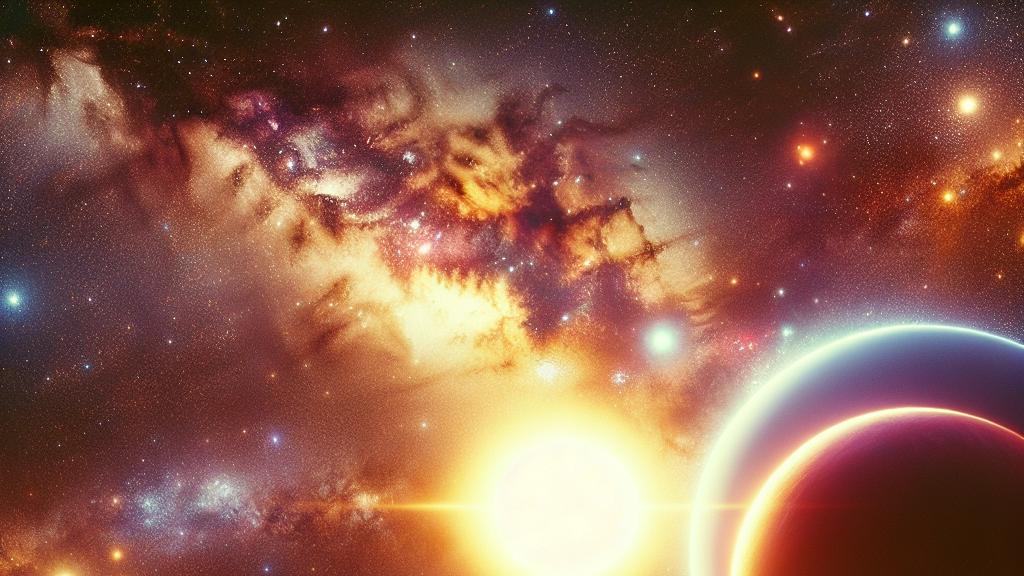
Ever dreamed of a vacation where you could watch two sunsets at once? Thanks to recent discoveries, this could one day be possible! In a thrilling twist of cosmic science, astronomers have found a new planet that orbits not one but two stars, marking an exciting leap in the study of planets that circle close binary stars.
Using advanced techniques like radial velocity measurements, scientists during the BEBOP survey have pinpointed a planet that dances around a pair of stars, taking around 550 days to complete its orbit. This discovery is remarkable because it challenges our understanding of how planets form and move in such intricate stellar systems. Unlike most known circumbinary planets, which typically have shorter orbits, this newfound world boasts a more extended path and a distinctively eccentric orbit that piques the curiosity of researchers.
Imagine a future where traveling to distant planets becomes as commonplace as booking a flight to a tropical island. This discovery not only adds a new planet to our cosmic map but also hints at the possibility of finding other stable worlds in similar star systems. With more research, we might one day identify planets with environments suitable for exploration or even habitation. The universe is vast, and who knows what other wonders await us in the dance of the stars?
Circumbinary planets experience eclipses where one star blocks the other, creating unique daylight patterns.
FAQs
What is a circumbinary planet?
A circumbinary planet is a planet that orbits around two stars instead of just one, like the planets in our own solar system. This means it experiences unique gravitational dynamics and sometimes even double sunsets, akin to science fiction.
How was the new circumbinary planet discovered?
The new planet was discovered using radial velocity measurements from the SOPHIE spectrograph at the Observatoire de Haute-Provence. This method tracks tiny movements in the stars caused by the gravitational pull of an orbiting planet, revealing its presence and characteristics.
Why are circumbinary planet discoveries important?
Discovering circumbinary planets is crucial because it helps scientists understand the processes of planet formation and migration in complex environments, which could one day lead us to new habitable worlds or contribute to the search for extraterrestrial life.
What makes the planet from the BEBOP survey unique?
The planet discovered during the BEBOP survey is unique due to its long orbital period of 550 days and high eccentricity, differing from most previously known circumbinary planets, which typically have shorter orbits.
Could humans visit a circumbinary planet someday?
While current technology doesn’t allow for human travel to distant planets, studying circumbinary planets could one day reveal planets with environments suitable for exploration, setting the stage for future space travel advances.
Background
A circumbinary planet is one that orbits a pair of stars, unlike Earth, which orbits just one. To discover such planets, scientists use a technique called radial velocity, which measures the slight wobble in stars caused by the gravitational pull of an orbiting planet. This sophisticated technique allows astronomers to detect even distant planets that can’t be seen directly through telescopes.
History
The search for planets outside our solar system, or exoplanets, has been a hot topic ever since the first one was discovered in 1992. Over the years, technology has greatly improved, allowing the discovery of planets in various star systems. The Kepler Space Telescope, launched in 2009, opened up new possibilities for finding exoplanets, including those orbiting binary stars, but recent advances in ground-based telescopic technology have refined these discoveries, leading to new insights like those found in the BEBOP survey.
Based on “BEBOP VII. SOPHIE discovery of BEBOP-3b, a circumbinary giant planet on an eccentric orbit” by Thomas A. Baycroft, Alexandre Santerne, Amaury H. M. J. Triaud, Neda Heidari, Daniel Sebastian, Yasmin T. Davis, Alexandre C. M. Correia, Lalitha Sairam, Alix V. Freckelton, Aleyna Adamson, Isabelle Boisse, Gavin A. L. Coleman, Georgina Dransfield, João Faria, Salomé Grouffal, Nathan Hara, Guillaume Hébrard, Vedad Kunovac, David V. Martin, Pierre F. L. Maxted, Richard P. Nelson, Madison G. Scott, Owen J. Scutt, Matthew R. Standing, available on arXiv (arxiv.org/abs/2506.14615), used under CC BY 4.0 (creativecommons.org/licenses/by/4.0/).