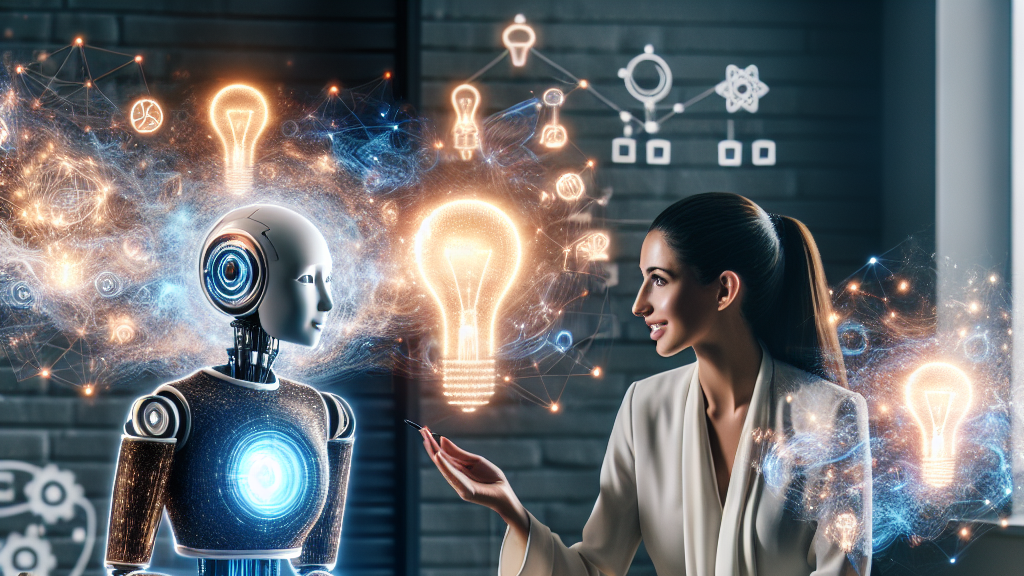
**Imagine a world where computers could help us think smarter!** That’s exactly what scientists are exploring by trying to teach artificial intelligence (AI) how to share its know-how in ways that humans can grasp and use. The big question they are tackling is whether AI can pass down its problem-solving skills to us, making us better decision-makers in our everyday lives. This isn’t just about getting answers, but truly understanding the ‘why’ and ‘how’ behind them.
The study, known as KITE (Knowledge Integration and Transfer Evaluation), dives deep into how well AI can communicate its reasoning. Participants worked with AI to brainstorm strategies on solving problems and then went their own way to see if they could apply these insights independently. Surprisingly, they found that while AI’s performance was linked to better human outcomes, it wasn’t always a sure thing. Factors like how people interacted with the AI and the strategic decisions they made played a big role.
Imagine if your morning routine could be upgraded or your next big decision in life could be made more confidently with a bit of AI guidance. That’s the future this research points towards—AI that doesn’t just answer our questions but teaches us in the process. As AI continues to evolve, this study is paving the way for communicative models that help us not just live smarter but think smarter, too!
Did you know? While an AI might solve a problem quickly, teaching humans its strategy can be a game of hit or miss!
FAQs
How does AI reasoning enhance human problem-solving skills?
AI reasoning enriches human problem-solving by offering new strategies and perspectives that humans might not consider. By effectively communicating its reasoning, AI helps people understand, apply, and learn these strategies for better decision-making.
What is KITE, and why is it important?
KITE stands for Knowledge Integration and Transfer Evaluation. It’s a framework developed to measure how well AI can transfer its reasoning knowledge to humans, highlighting both the potential and challenges in creating AI that communicates effectively with people.
What surprising results were found in the AI knowledge transfer study?
The study revealed that while AI’s high performance is linked to better human outcomes, this relationship is inconsistent due to strategic and behavioral factors, suggesting the need for optimizing AI models for better communication.
Will AI ever be able to teach humans effectively?
This research suggests that while AI has potential, achieving effective teaching requires more than just high performance. It demands models specifically designed for human communication to bridge the gap between AI knowledge and human understanding.
Why is AI’s ability to communicate with humans important?
AI’s communicative abilities are crucial for integrating it into everyday life, helping us make more informed decisions and enhancing our cognitive processes by learning from AI’s problem-solving methods.
Background
Artificial intelligence reasoning refers to the capability of AI systems to simulate human-like thinking processes to solve problems, make decisions, and generate predictions. Knowledge transfer in this context means the ability of AI to not only apply its reasoning skills but also effectively communicate these skills so humans can learn and benefit from them. This involves providing explanations that are understandable and usable by people in various situations.
History
The field of AI has rapidly evolved, initially focusing on achieving high performance in specific tasks, such as playing chess or identifying objects in images. As AI technologies matured, researchers became curious about its potential to collaborate with humans, helping us learn and make better decisions. Previous studies have explored machine learning and natural language processing, paving the pathway for the current research into AI’s communicative ability, thus opening new doors to human-AI collaboration.
Based on “When Models Know More Than They Can Explain: Quantifying Knowledge Transfer in Human-AI Collaboration” by Quan Shi, Carlos E. Jimenez, Shunyu Yao, Nick Haber, Diyi Yang, Karthik Narasimhan, available on arXiv (arxiv.org/abs/2506.05579), used under CC BY 4.0 (creativecommons.org/licenses/by/4.0/).